Monday, February 24, 2014

The most common delta V error

Patching Conics
Time and time again I've watched people patch conics by using straight addition and ignoring the Oberth benefit. It is a very easy mistake to make. I'll give an example of this error for an earth to Mars delta V budget.


At perihelion an earth to Mars Hohmann orbit is moving about 33 km/s. 3 km/s is needed to leave earth's 30 km/s heliocentric orbit and enter this transfer orbit. In a similar fashion it takes 2.5 km/s to leave Hohmann transfer and match velocities with Mars.

But before we go from one heliocentric orbit to another, we need to escape the planet's gravity well. Earth's surface escape velocity is about 11 km/s. Mars' surface escape velocity is about 5 km/s.

The novice will look at these 4 quantities and simply add them. 11 + 3 + 2.5 + 5 is 20.5. They'll tell you it takes about 20.5 km/s to get from earth's surface to Mars surface.

But to accurately patch conics you need to use the hyperbolic orbit that takes you out of the planet's sphere of influence to a heliocentric orbit. Hyperbolic orbit speed is sqrt(Vescape2 + Vinfinity2). But what's Vinfinity? In this example it's the 3 km/s needed to go from earth's 30 km/s orbit to a Hohmann's 33 km/s. In Mars' neighborhood Vinfinity is the 2.5 km/s needed to exit Hohmann and match velocities with Mars.

If you remember high school math, sqrt( a2 +  b) should look familiar. It's the hypotenuse in the good old Pythagorean theorem! And that's what I use to visualize hyperbola speed:


The novice will tell once you've achieved the 11 km/s to escape earth's gravity well, you need another 3 km/s. The informed will tell you only another .4 km/s is needed.


For Mars to Earth the naive will tell you after you've reached 5 km/s to escape Mars then you need another 2.5 km/s to send the ship earthward. The savvy will tell you an additional .6 km/s is needed.


.4 vs 3 and .6 vs 2.5. In this case the novice method results in a 4.5 km/s overestimation of the delta V budget.

Erik Max Francis
I used to call this the Erik Max Francis Error. Delta V budgets from one planet to another would often come up in space usenet groups. Erik would use his Python BOTEC and give an answer to ten decimal places. People would ooooh and ahhhhh. Wow! Accurate to 10 significant figures! In reality Erik's answers were accurate to zero significant figures. I finally prodded him to correct his error. Now his BOTEC is accurate to 1 or 2 significant figures. So far as I know, he still gives answers to 10 decimal places.


Rune
Later I called it the Rune error. The total Vinf can be roughly estimated by subtracting Mars 24 km/s from earth's 30 km/s. And this is what Rune uses on the New Mars forum when Louis asks how much delta V is needed after you get out of earth's gravity well.
Brute force" trajectories would take about as much delta-v as is the difference between the orbital speeds of mars and earth, so about 29.8km/s (for earth) - 24km/s (for mars) = 5.8km/s
I have explained to the New Mars Forums many times that the speed of a hyperbola is sqrt(Vescape2 + Vinfinity2). Will Rune ever learn it? I doubt it.

But no matter, Rune's a member of Zubrin's cult. People expect Zubrinistas to be innumerate, nobody takes  them seriously. But sadly they are loud and high profile. John Q Public can be misled into thinking they speak for all space advocates.

It's more damaging when someone in authority commits this error.  Now I'm talking about Dr. Tom Murphy.

Professor Tom Murphy
This is from a graphic from Tom Murphy's Stranded Resources:


Murphy writes:
For instance, we travel around the Sun at a velocity of 30 km/s, while Mars sails at a more sedate 24 km/s. So to meet up with Mars, we have 6 km/s of extra velocity to burn, helping us up the hill. We speak of this as a Δv (delta-vee) adjustment to trajectory.
Same method as Rune for getting the total Vinf: Subtracting Mars' 24 km/s from earth's 30 km/s to get 6 km/s. An over estimation but not wildly inaccurate. And Murphy correctly shows earth's escape as 11 km/s and Mars escape as about 5 km/s.

But then Murphy straight up adds 11+6+5:

Crudely speaking, we must have the means to accomplish all vertical traverses in order to make a trip. For instance, landing on Mars from Earth requires about 17 km/s of climb, followed by a controlled 5 km/s of deceleration for the descent. Thus it takes something like 20 km/s of capability to land on Mars
Sounds like he's being generous to the poor deluded space cadets by rounding 22 down to 20. But the distance from earth's C3=0 to Mars C3=0 is not 6 km/s. It's about 1 km/s. Here's Murphy graph corrected for the Oberth benefit:


For comparison, Murphy's erroneous graph is left in but a shade lighter. From surface of Earth to Surface of Mars is about 16 km/s.

"But wait!" a Murphy apologist might say. "Murphy didn't include the delta V needed to rise above earth's atmosphere. That's 1.5 to 2 km/s! That makes the budget more like 18 which can be rounded up to 20."

An atmosphere does indeed add to delta V for departing a planet. On the other hand, an atmosphere is a big help for planet arrival. Park in a capture orbit with periapsis velocity just a hair under escape. Position the periapsis in the planet's upper atmosphere. Each orbit at periapsis, atmospheric friction slows the ship. This is known as aerobraking. Almost all of Mars' 5 km/s descent can dealt with via aerobraking. Here is Murphy's graph corrected for atmospheric influence:


Now it takes 13 or 14 km's to reach escape. But with descent taken care of with aerobraking it only takes another 1 km/s to reach Mars' surface. A more realistic delta V budget from earth surface to Mars surface is about 14 or 15 km/s.

And in fact numerous Mars landers and orbiters have used this method. I am stunned that Murphy, a self proclaimed space insider, has never heard of aerobraking.

Is a 6 km/s error a big deal? Since the exponent of the rocket equation scales with delta V, it's a very big deal. Murphy himself would tell you exponential growth can be dramatic.


Above graph assumes hydrogen/oxygen bipropellent. Each 3 km/s added to the delta V budget about doubles propellent needed. Each 5 km/s added nearly triples the amount. Murphy's 20 km/s delta V budget would need a little more than triple the propellent of the actual 15 km/s delta V budget.


In my opinion the limits to growth is the most important issue facing us. Can space resources raise the ceiling on our logistic growth? If so, it is worthwhile to invest in building space infra-structure. If not, expensive space infrastructure is a waste of money. We should look at the question seriously. That is why I get bent out of shape when a so-called authority makes common mistakes that would embarrass a freshman aerospace student.

Tom Murphy's arguments against space are often cited in discussions of limits to growth. When I find such a discussion, I will chime in that a bright high school student could tear apart Murphy's arguments. The most recent visit was at Mike Stasse's Damn The Matrix. As usual, the Do The Math crowd response was insults, appeal to authority, but no math.


Judging by Murphy's fans, his blog should be renamed "Don't do the Math. Take my word for it because I'm a Ph. D."


Saturday, February 1, 2014

Terraforming Mars vs Orbital Habs


__________________________

Those who advocate Mars settlement like to say Mars can be terraformed. First I will take a look at what it would take to terraform Mars.

How much air do we need to add to Mars?


From NASA's Mars Fact Sheet, surface density of the Martian atmosphere is about .02 kg/m3. That is about 1.5% of Earth's surface air pressure of 1.27 kg/m3. Mars' atmosphere is virtually a vacuum.

Mars surface gravity is about 38% earth gravity. That means given an atmosphere of comparable temperature and composition, Mars atmosphere scale height is 264% earth atmosphere scale height. But Mars surface area is about about 28% that of earth's. 2.64 * .28 is about .75. To get comparable air density, we would need Mars' atmospheric mass to be about three quarters that of earth's atmosphere.

The total mass of the Martian atmosphere is about 2.5 x 10¹⁶ kg. Earth's atmosphere is about 5 x 1018 kg. So to make Mars surface air density earth like, we'd need 3.6 x 1018 kg of air added to Mars.

But do we need sea level air density? No, there are people who survive at higher elevations. This list of the world's highest cities show several places at around 5000 meter elevation. Granted the dwellers of the highest city La Rinconada, Peru don't live comfortably. But they demonstrate humans can endure air density half that of sea level. If half is sufficient, Mars only needs 1.8 x 10¹⁸ additional kilograms of air.

Would be Mars terraformers like to point at the frozen CO2 at the Martian poles. If Mars temperature is raised just a little, they hope the vaporized carbon dioxide would create a greenhouse effect that would cause more carbon dioxide to be vaporized. Their hope is that a runaway greenhouse effect could substantially boost Mars' atmosphere from frozen volatiles already in place.

According to Wikipedia, there is thought to be a 1 meter thick layer of CO2 at Mars north pole, a cap about 1,000,000 meters in diameter. At the south pole there is an 8 meter thick layer of CO2 over a cap having a 350,000 meter diameter. That's about 1.6 x 10¹² cubic meters of CO2. Dry ice has a density of 1.6 thousand kg/m3. If all of that CO2 is vaporized (an optimistic assumption) that totals about 2.5 x 10¹⁵ kg of atmosphere. Short by almost 3 orders of magnitude, a miniscule contribution toward the needed 1.8 x 10¹⁸ needed kilograms.

Zubrin and McKay believe runaway greenhouse could boost Mars atmosphere to 300 to 600 millibars. Besides the polar dry ice, they also mention CO2 in Martian regolith. I believe most of Zubrin's optmistic estimates are influenced more by wishful thinking than hard data. But for the sake of argument I'll grant 300 millibars of CO2. 300 millibars of CO2 is not breathable. But let's say green plants combine Martian water and CO2 to make sugars and starches plus oxygen. Taking the carbon out of 300 millibars of CO2 leaves about 220 millibars of oxygen. Earth's 1000 millibar atmosphere is 1/5 oxygen, so perhaps a 220 millibar oxygen atmosphere would be breathable. But it would also be an extreme fire hazard. Apollo 1 taught us a pure oxygen atmosphere isn't a good idea.

Even with Zubrin's very optimistic scenario, it seems we'd still need to import 1.5 1x 10¹⁸ kilograms of nitrogen.

Can we add to Mars' air with comets?


Zubrin and McKay suggest  it'd take .3 km/s to nudge an ammonia asteroid in the outer solar system towards Saturn and then Saturn's gravity could throw the ammonia snowball Marsward.

"Consider an asteroid made of frozen ammonia with a mass of 10 billion tonnes orbiting the sun at a distance of 12 AU. Such an object, if spherical, would have a diameter of about 2.6 km, and changing its orbit to intersect Saturn's (where it could get a trans-Mars gravity assist) would require a DV of 0.3 km/s. If a quartet of 5000 MW nuclear thermal rocket engines powered by either fission or fusion were used to heat some of its ammonia up to 2200 K (5000 MW fission NTRs operating at 2500 K were tested in the 1960s), they would produce an exhaust velocity of 4 km/s, which would allow them to move the asteroid onto its required course using only 8% of its material as propellant. Ten years of steady thrusting would be required, followed by a about a 20 year coast to impact. When the object hit Mars, the energy released would be about 10 TW-years, enough to melt 1 trillion tonnes of water (a lake 140 km on a side and 50 meters deep). In addition, the ammonia released by a single such object would raise the planet's temperature by about 3 degrees centigrade and form a shield that would effectively mask the planet's surface from ultraviolet radiation. As further missions proceeded, the planet's temperature could be increased globally in accord with the data shown in Fig. 12. Forty such missions would double the nitrogen content of Mars' atmosphere by direct importation, and could produce much more if some of the asteroids were targeted to hit beds of nitrates, which they would volatilize into nitrogen and oxygen upon impact. If one such mission were launched per year, within half a century or so most of Mars would have a temperate climate, and enough water would have been melted to cover a quarter of the planet with a layer of water 1 m deep."

This scheme presupposes we could land a 20 gigawatt power source on a rock in the outer solar solar system. For comparison the Palo Verde Nuclear Power Plant, the largest nuclear power plant in the United States, produces about 3.3 gigawatts. So we're sending 6 Palo Verde Nuclear Power Plants out past Saturn. McCay's scheme stipulates using the comet's mass as reaction mass. So now we have a mining and transportation infra structure on the comet that digs up the ice and places this reaction mass in the nuclear rocket engine.

If we have the wherewithal to establish such infrastructure, we certainly have the ability to build habs on these rocks.

Asteroidal Real Estate


How much asteroidal real estate could 1.5 1x 10¹⁸ kilograms of air give us? An O'Neill cylinder 8 kilometers in diameter and 32 kilometers long would give us 804 square kilometers of real estate. Such a cylinder would have a volume of 1.6e12 cubic meters. On earth's surface, our air has a density of about 1.27 kg per cubic meter. So that volume at 1 bar density would be 2e12 kilograms of air.

1.5e18/2e12 = 750,000. Three quarters of a million O'Neill habitats. Recall each cylinder has 804 square kilometers of real estate. 750,000 * 804 km2 = 603 million km2. Mars' surface area is 145 million km2. So if we put the asteroidal resources to use where they're at, we get 4 times as much real estate.

Some would point out that O'Neill cylinders are very extravagant pieces of mega-engineering. I completely agree! It's my belief that humans don't need a full g to be healthy, I believe .4 g (a little more than Mars' gravity) would suffice. In which case the hab radius could be 1.6 km. Such a hab would have only  321 km2 of real estate but a volume only 2.6e11 cubic meters. 2.6e11 m3 * 1.27 kg/m3 = 3.3e11 kilograms. 1.5e18/3.3e11 = ~4.5 million. 4.5 million of the smaller O'Neill habitats. 4.5 million * 321 = 1460 million square kilometers. Or about as much real estate as 10 Mars planets.

If the goal is to provide more real estate and resources for humanity, terraforming Mars is an extravagant waste. We should ditch planetary chauvinism and go for the small bodies.

Robert Walker also takes a look at terraforming Mars.


Saturday, December 28, 2013

EML2 plane change

Most of my models use circular coplanar orbits. But Jon Goff points out many asteroids have a healthy inclination. Departing for an asteroid from the moon's orbital plane often involves a big plane change. And plane changes can be expensive (see comments in What about Mr. Oberth?)

But easy plane changes is a big reason I love EML2. This takes some explaining.

Let's look at a 60 degree plane change but no change in speed. I pick 60º because it's easy-- the original and new velocity vector as well as the delta V vector are all sides of an equilateral triangle.


If your speed is about 8 km/s (as in low earth orbit), a 60 degree plane change costs about 8 km/s.

With higher orbits, plane changes are cheaper. At GEO (about 36,000 km above earth's surface), orbit speed is about 3 km/s and a 60 degree plane change costs 3 km/s.

EML2 is about 63,000 kilometers above the moon's surface. It's moving about .17 km/s with regard to the moon. So a 60 degree plane change at EML2 costs .17 km/s:


But wait, it gets even better!

My favorite route from LEO to EML2 is the one found by Robert Farquhar:

The orbit is time reversible. A .15 km/s braking burn at EML2 cuts speed with regard to the moon to .02 km/s. The allows the ship to fall deep into the moon's gravity well. With the a little Oberth help at perilune, another .18 km/s suffices to send the ship to an 182 km perigee.

Here's a single burn at EML2 that cuts speed to .02 km/s as well as doing a 60 degree plane change:


The .16 km/s braking/plane change burn is only .01 km/s more than the .15 km/s coplanar burn Farquhar calls for.

Where else can you get a 60º plane change for only .01 km/s?

EML2 has a tiny C3 with regard to both the moon and earth. This confers a big Oberth advantage. And the easy plane change is icing on the cake.

Edit: Isaac Kuo has pointed out that earth has a 30 km/s vector coplanar to the ecliptic plane. A hyperbolic orbit departing earth might have a v infinity of 3 or 4 km/s. When you add a 3 or 4 km/s vector tilted 60 degrees to the 30 km/s vector, you are only inclined 4 or 5 degrees from the ecliptic plane. Still, this is a substantial plane change! This post is incomplete as I've only looked at departure from EML2. Hopefully, I'll soon have time to look at burns at perilune and perigee burns and the possible trans asteroid orbits.

Friday, December 27, 2013

Who needs humans?

This is in response to Quantum G's question "Why do humans need to return to the Moon to get resources to make "consumables and propellant", if robots can be sent to do that instead?"

Just let autonomous and/or teleoperated robots do all the work. Who needs humans?

Quantum G should try working in an actual mine. As an ASU student, I spent four summers working in the Phelps Dodge copper mine in Ajo, Arizona. At the top of every bulletin board was Murphy's Law: "What Can Go Wrong, Will."  And that was followed by many variations and corollaries of Murphy's Law.

Unlike a factory floor, mines are an uncontrolled, unpredictable environment. The unexpected can and does happen. When it does, human ingenuity is called for. You cannot write algorithms that anticipate every unforeseen problem.

Not that I'm against robots. See
Puppets, Telerobots & James Cameron,
Surgical Robots, and
Give NASA's SLS money to DARPA.
I believe improved robotics will be a major game changer when it comes to exploitation of space resources.

The moon is more amenable to tele robots than most locations in our solar system. At 384,400 kilometers from earth, light lag latency is only 3 seconds. Since signal strength falls with inverse square of distance, lunar tele robots would enjoy much better bandwidth than machines on remote asteroids or Mars. Good bandwidth is important for immersive tele-presence as well as control of agile, dexterous robots.

And there are technologies that can mitigate a 3 second reaction time. For example Big Dog's balance or Google Car's collision avoidance.

Even so, a multitude of tasks are much easier with constant sensory feedback in real time. Things like finding a dropped hex nut. A 3 second light lag can make normally quick and easy chores time consuming and difficult. Robots controlled by humans in neighboring habs would be much more able than bots controlled from earth's surface.

And then there's the question of maintenance. Who maintains the robots?

Here is an article on mining giant Rio Tinto's "autonomous" robots. These driverless trucks move back and forth along well maintained and predictable routes. And they are closely monitored by nearby humans. Machines in less predictable environments such as the shovels are still human operated. And all the machines, whether "autonomous" or human operated, are maintained by humans.

Mines sans humans are still well beyond the state of art for earthly mines, much less mines in environments where we have zero operating experience.

Robots may reduce the need for human presence. But they won't completely eliminate the need for humans, not for a long while.

There is also important information to be gained from humans on the moon. What gravity do humans need to stay healthy? As I mention in What's the minimum spin hab?, this is still not known. If the moon's 1/6 gravity keeps humans healthy, that makes minimum spin habs for asteroid workers more than six times less massive. It would also indicate humans are okay living with Martian gravity.

Friday, December 20, 2013

What's the minimum spin hab?

This post was prompted by Robert Walker's comment: "I wonder what anyone here thinks about my idea for rotating carousels to provide gravity in the lunar colony? Not rotating entire hab, but just a thin shell of living quarters inside it, in a bigger hab if say a couple of hundred meters across, greenhouse domed, have like the living habs around the outside rotating continuously - perhaps on a track or something like that - at just the right speed for 1 g for the inhabitants. Smaller habs just rotate the entire room - and easier to construct than e.g. fairground rides on Earth because of the low gravity."

We know 0 g results in bone loss and other problems. We need gravity, but how much?

Is 2/5 g (Mars gravity) sufficient to keep us healthy? Or 1/6 g (moon gravity)? This is still not known. Our only data points are 0 g and 1 g. If a full g is needed, people on Luna or Mars bases would indeed need living quarters on rotating carousels.

On the other hand, if lunar gravity is sufficient, no carousel is needed on the moon or Mars. That would also drasticly cut the minimum sized hab needed to keep workers healthy in a microgravity environment like on an asteroid.

The amount of artificial gravity felt in a spin hab is ω2r where ω is angular velocity in radians and r is spin hab radius. Obviously if 1/6 g does the job, the hab radius can be cut by a factor of 6.

Another quantity to look at is ω, angular velocity. Earlier it was believed 1 revolution per minute was the top angular velocity humans could comfortably endure. This combined with assuming a full gravity resulted in proposals like the behemoth Stanford Torus. (2 * pi / 60 seconds) * 894 meters = ~9.8 meters/second^2 or about 1 gravity.

If spinning doughnuts nearly 2 kilometers across are a prerequisite for asteroid miners, I wouldn't expect asteroid mining habs in this century or the next.

But is 1 revolution per minute really the top ω workers can endure? Research by James Lackner and Paul DiZio suggests workers could become acclimated to higher angular velocities. If workers can get used to 2 rpm that would cut needed radius four fold. 3 rpms would cut radius 9 fold. Here is a table showing hab radius (in meters) that be needed for various angular velocities and gravities:

1 g 5/6 g 2/3 g 1/2 g 1/3 g 1/6 g
1 rpm
894
745
596
447
298
149
2 rpm
223
186
149
112
75
37
3 rpm
99
83
66
49
33
16
4 rpm
56
46
37
28
19
9

If lunar gravity is sufficient and workers can get used to 4 rpms, a 9 meter radius hab does the job!

Obviously a 9 meter radius spin hab is more doable than a 900 meter radius Stanford Torus.

While we're talking about effects of microgravity, let's take a look at cosmonaut Valeri Polyakov. From a SpaceDaily article: "Polyakov's space flight had lasted 438 days (bettering a year by more than two-and-a-half months). Yet upon return, his health was not much different than other cosmonauts' after a long flight. After those first steps, he completely readapted to gravity within two months. Moreover, his bone loss had been very low, only around 7 percent in some of his weight-bearing bones," 

 Granted, only a small fraction of us have the self discipline to adhere to Polyakov's exercise regimen. But he demonsrates that exercise can mitigate microgravity bone loss.


If you hope for humans on surface of other planets or in asteroidal habs, it would be good to know what gravity humans need and what angular velocity they could get used to.

Scott Manley did a nice video on spin habs.

Saturday, December 14, 2013

Arrgh! It's not the cost of the fuel

"What's the cost of propellant from earth vs getting it from the moon?" always comes up in discussions of lunar water. Or the cost of near earth asteroid propellant vs earth propellant.

Propellant is cheap, typically a small percentage of spacecraft expense. Spaceflight is expensive because vehicles are disposable. How much would a plane ticket cost if a 747 were thrown away each trip?

Well, how come we don't re-use our spaceships? It's due to constraints imposed by the rocket equation.

As delta-V budget  climbs, dry mass fraction shrinks. We can't eliminate engine or payload mass. We cut dry mass by making walls thinner and structure more tenuous.


Thinner walls mean fragility. Designing upper stages is like designing egg shells.

Upper stages are like cascarónes, confetti eggs. While cascarónes are fragile by design, upper stages are fragile due to the constraints imposed by the rocket equation and high delta-V budgets. An upper stage plunging into the atmosphere is like a cascarón plunging onto a friend or relative's head. But the conditions of re-entering earth's atmosphere at 8 kilometers/second are much more extreme than the back of her mom's head.


Given propellant depots at LEO, GEO, and EML1 or 2, ferries between orbits would have delta V budgets of 4 km/s or less. Moving between orbits, they don't have to endure re-entry. Much less difficult mass fractions and eliminating the extreme conditions of re-entry make re-usable ferries doable.

But how would these ferries by fueled? Tankers from earth would have a delta V budget of at least 9.5 km/s. If the tankers are throw-away, it is simpler and cheaper to just use the tanker to deliver the payload rather than fueling a ferry to deliver a payload.

However if the fuel source is the moon's surface or an asteroid at EML1 or 2, the tankers have lower delta V budgets and thus much less difficult mass fractions. Given reusable tankers to supply fuel, reusable ferries make sense.

Moreover, given propellant in LEO, an upper stage returning to the earth's surface doesn't have to re-enter at 8 km/s. Given propellant in LEO it can refuel and shed some of it's orbital velocity via reaction mass instead of aerobraking. Eliminating the 8 km/s re-entry makes re-use of upper stages much less difficult.

So it's completely missing the point to compare the price of earthly propellant delivered to the moon's surface vs propellant mined on the moon. The object isn't to get water on the moon's surface. The object is to get propellant at various locations in cislunar space so the delta V budgets can be busted into manageable chunks.

By breaking the tyranny of the rocket equation, reusable ships become possible. Given easily reusable space ships, the economies of spaceflight are completely changed. This is the potential of lunar (or NEO) water.

Sunday, October 20, 2013

What about Mr. Oberth?

On a space forum I was singing the virtues of EML1 and EML2, the earth-moon Lagrange regions closest to the moon. "What about Mr. Oberth?" asked a fellow who calls himself Rune.

This is a common complaint from Zubrin fans who prefer to depart for Mars from Low Earth Orbit (LEO). Zubrinistas point out there's a greater Oberth benefit doing a burn deep in a gravity well.

What is the Oberth benefit? Why is there a bigger Oberth benefit deep in a gravity well?

The Oberth benefit gives a lot of extra kinetic energy for a small change in speed.

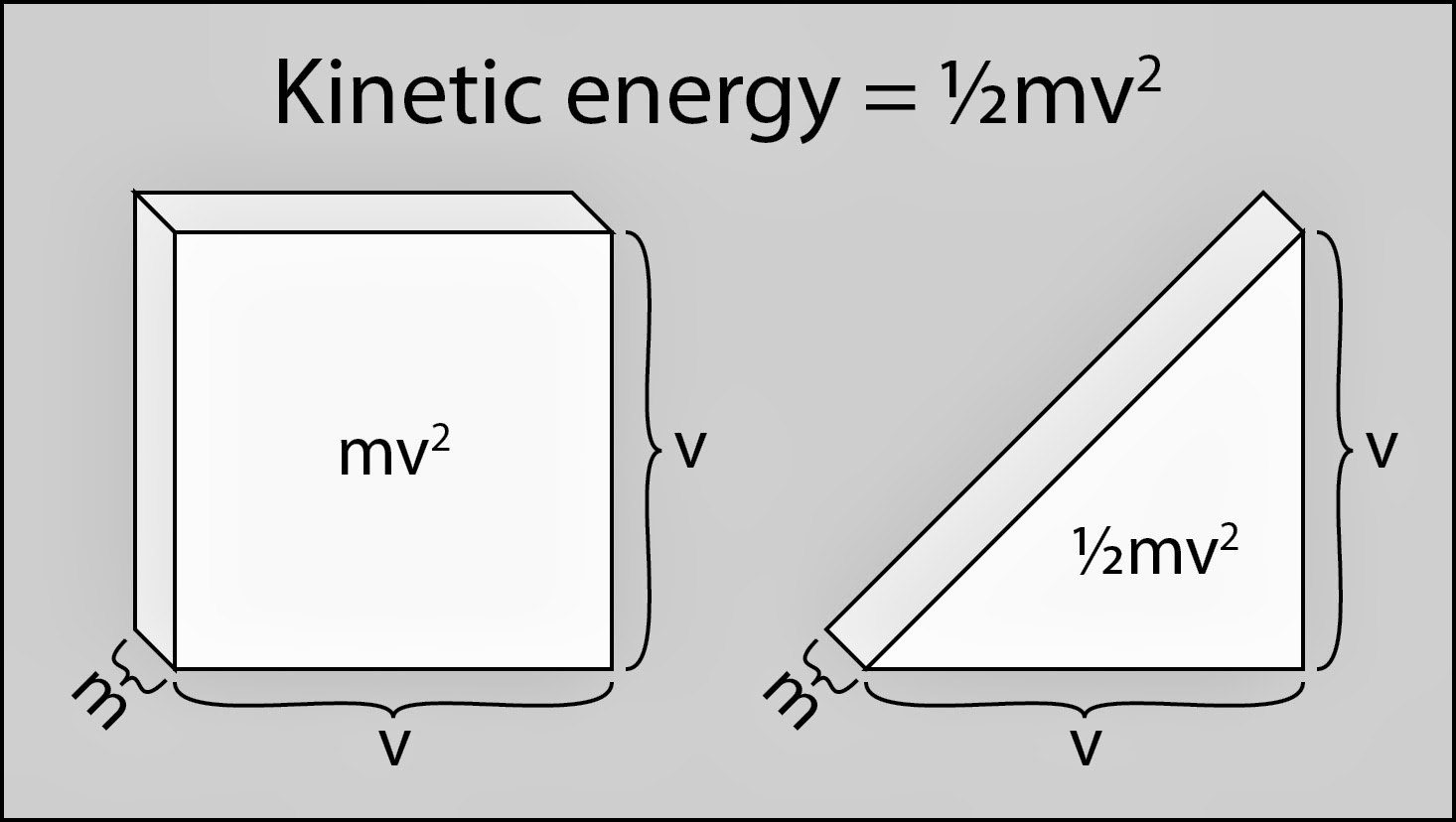
Kinetic energy is equal to 1/2 * mass * velocity2. A way to visualize the product of three factors (mass * velocity * velocity) is as a rectangular solid:


To get 1/2 mv2, just cut the square diagonally from corner to corner as shown above.

What happens if you're already going fast and speed up a litte more? Say you increase your speed v by vb, velocity from a rocket burn. Here's a picture:


Take 1/2 of m (v + vb)2, and you get 1/2 mv2 as well as 1/2 mvb2, the kinetic energy you might expect from adding these two speeds. On top of that, you also get m(v * vb). The pink rectangle above is Oberth gravy.

For example a kilogram going 10 meters/second has kinetic energy of 50 joules; a kilogram going 2 meters/second has kinetic energy of 2 joules. But a kilogram moving (10 + 2) meters/second doesn't have a kinetic energy of 52 joules, rather (50 + 2 + (10 * 2)) joules. Starting with a 10 meter/second speed and speeding up another 2 meters a second gives you a 20 joule Oberth benefit.

So accelerating a mass already moving fast gives you more kinetic energy for your buck. But what does that have to do with doing a burn deep in a gravity well?

A fair model of a gravity well is a vortex wishing well. You've probably seen this in a shopping mall or science museum:

Photo used permission of Michael Hanna of Online Vending.

If you've played with one of these things, you know the coin starts rolling slowly around the outer portion of the funnel. As it moves inward it rolls ever faster until it's spinning furiously at the center. In a similar fashion, satellites far from the earth orbit sedately, but sats in low earth orbit zoom along at about 8 km/s. But unlike the vortex wishing well coin, satellites aren't slowed by friction so they stay in more or less circular orbits instead of spiraling inward as the coin does.

So now Rune's question makes more sense. Here's a picture of Rune zooming around deep in earth's gravity well while I'm just barely moving at the well's edge:


Vinfinity for a Mars Hohmann is about 3 km/s. From low earth orbit it takes a little more than 3 km/s to achieve escape velocity. You'd think to get escape plus 3 more km/s for Vinfinity would take around 6 km/s. But due to the Oberth benefit it only takes 3.6 km/s for Trans Mars Injection (TMI) from LEO.

From an orbit in the moon's neighborhood, it only takes about .5 km/s to escape from earth's gravity well. But there is less Oberth benefit when you're only moving 1 km/s. For TMI, I would need to stomp on the gas and speed up 2.5 km/s.

But I don't stomp on the gas.

Rather, I tap the on the brake.


Recall high earth orbits are slow. It takes only a small deceleration to kill most of your orbital speed. With almost no orbital speed holding me aloft, I drop like a stone towards the earth.

When I'm approaching perigee, I've already fallen from a great height. I am traveling just a hair under earth's escape velocity.


Rune is still traveling about 8 km/s, orbital speed for a circular low earth orbit. But I'm traveling almost 11 km/s.


I zoom past Rune like he's standing still.

To give some numbers, a .7 km/s deceleration suffices to drop from EML1 to a perigee deep in earth's gravity well. At perigee the ship is traveling 3.1 km/s faster than a circular low earth orbit. So the net delta V advantage over LEO is 2.4 km/s.

EML2 is similar but a little more complicated. .2 km/s suffices to drop from EML2 to a perilune deep in the the moon's gravity. A little .2 km/s tap on the gas at perilune enjoys an Oberth benefit from the moon's gravity well to send the ship earthward. So it only takes .4 km/s to reach a low perigee. This perigee is also moving about 3.1 km/s faster than LEO, so the advantage is 2.7 km/s.


More on the Oberth Effect can be found at Winchell Chung's Atomic Rockets.

Moreover, earth propellant most climb a much steeper gravity well before reaching space. EML1 and 2 are only 2.5 km/s from potential propellant in the lunar cold traps.


So to answer Rune's question, It's largely because of the Oberth effect that EML1 and especially EML2 are so attractive. Those who believe circular LEOs have an Oberth advantage forget that high earth orbits can easily reach a deep perigee with a small tap of the brakes.