Sunday, June 30, 2013

Even MIT students can make misteaks.

Finding Delta V between various places in the solar system has been one of my hobbies. I like to learn as well as share what I know about this topic. So I occasionally Google search strings that include the term "Delta V".

Googling: Delta V Mars. The first hit is a Wikipedia article, the second hit is How Much Delta V do you need to get to Mars - Yahoo! Answers.

A fellow who calls himself ronwizfr confidently asserts that the delta V from earth orbit to Mars transfer is 6.6 km/s. Ronwizfr cites an MIT student project for a class called Solving Complex Problems.


The MIT page cited is a well done presentation until the students get to constants:


Then the students made an arithmetic error. The distance from the earth to the sun is 1.49X10¹¹ meters, not 1.49X10¹⁰ meters. Their radius for Mars' orbit is also off by a factor of 10.

The MIT students correctly plug in these wrong quantities to get speeds that are off by sqrt(10):


The velocity of the earth is not 94,384 m/s but closer to 29,846 m/s. Likewise velocity of Mars isn't 74,467 m/s but closer to 23,548 m/s. Their quantities would have been correct if the earth and Mars were .1 A.U. and .152 A.U. from the sun.

Even the very accomplished can make errors. So we should examine every assertion, no matter the source. My dad used to tell me we all put our pants on one leg at a time. His way of saying we're all human and capable of making mistakes.

Wednesday, May 15, 2013

Surgical Robots

At the Leprecon 39 Science Fiction Convention I attended a talk by Dr. Bruce Davis, a general/trauma surgeon in the Phoenix area.

Dr. Davis has done many laparoscopic surgeries using the da Vinci robot.  Instead of opening up a patient's belly, a small incision is made. A pair of robotic arms as well as a binocular pair of cameras are inserted through a small opening.

Davis reports that the two cameras give good depth perception. The telepresence is so immersive he often forgets he's not physically present inside the patient's body. He finds himself trying to turn his head to look about the cavity. Davis expects the robots will soon have motion capture for the head and neck so the camera motion will mimic the motion of the surgeon's actual eyes.

The arms are operated by motion capture. Robotic wrists mimic the motion of the surgeon's wrists. Instead of a thumb and four fingers, the robotic hand looks more like a crab's pinchers. The surgeon moves these pinchers with his thumb and index finger. Still, a lot can be accomplished with this simple hand.

The cameras give up to 10X magnification. When higher magnification is invoked, the motion of the robotic hands become more minute -- in effect shrinking the surgeon's avatar. We saw a video where a grape seemed like a large watermelon. The surgeon easily cut and peeled back a section of the grape's skin.

The robotic hands lack a sense of touch. Davis says the robot's designers are trying to figure out how to do haptic feedback but it's a challenging problem.

The da Vinci robot Davis uses costs 1.2 million dollars. I noted design and development is a large expense for early technologies. As more robots are made, design cost is amortized over more units and unit price can fall. Davis replied that this is happening to some extent. But da Vinci is the sole vendor in his field of robotic surgery and so has less incentive to drop their price.

I asked Dr. Davis if he foresaw uses of this technology outside of surgery. For example snaking robotic arms and eyes to a problem inside a utility line. This might avoid busting up a busy intersection with jack hammers and backhoes. Davis replied that this sort of application is likely and will probably lead to cheaper robots. Liability is a big expense in surgery. For example, a titanium screw breaking in a hip replacement can result in a major law suit. The same titanium screws that cost air lines $4.00 apiece are sold to surgeons at $400 apiece. Not having a heavy insurance burden, robots for plumbers and electricians can be less expensive and more common place than surgical robots.

I asked Davis if he thought telerobots could be used to build infrastructure on the moon or on an asteroid parked in lunar orbit. He said due to the 3 second light lag, motions would have to be very deliberate. But he thought it was doable. He mentioned there is a.i. being developed that mitigates slow reaction time caused by latency. For example, Big Dog's balance or Google Cars collision avoidance.

In Puppets, Telerobots and James Cameron, I opined that telerobots will be the game changer that enables use of space resources. I wrote that there are many uses right here on earth that are advancing telerobotic technology. So Davis' presentation was encouraging to me. Dr. Davis is also a science fiction writer.


Saturday, April 27, 2013

Cartoon Delta V Map


This is the second cartoon delta-v map I've drawn. Clicking on the above can give a larger version.

My first cartoon map gave a lot more space to EML5 and little to L1 or L2. I knew of L4 and L5 through fiction like Gundam which was probably inspired by Gerard O'Neill's The High Frontier. Since then I've become less interested in L4 and L5 and more interested in L1 and L2. This new map reflects that shift in focus.

I had heard of the Interplanetary Transport Network as well as Shane Ross, Martin Lo, and Edward Belbruno. But I knew almost nothing about the low delta V routes achieved with n-body mechanics. I had a vague notion that Lagrange points were involved but that was about it.

Then in 2009 I came across a thread in Nasa Space Flight entitled An Alternative Lunar Architecture. In that thread Kirk Sorensen wrote at length about EML2 and work done by Robert Farquhar. Farquhar's 3 body work was done in the late 1960's and early 70's, decades before Ross, Belbruno and other modern advocates of 3-body mechanics.

Here's one of the Farquhar graphics Sorensen posted to that thread:
This is a 9 day route from LEO to EML2 taking delta V of about 3.5 km/s. It's time reversible so .4 km/s can drop a payload from from EML2 to an atmosphere grazing perigee. There's a 4 day route to EML1 that takes 3.8 days. It was surprising to me that EML2 could be reached with less delta V even though it's on the far side of the moon.


It was in 2009 that I became more interested in L1 and L2.

There are routes between LEO and EML1&2 taking even less delta V, but these are time consuming. These are described by Andreas Stock's Investigation on Low Cost Transfer Options to the Earth-Moon Libration Point Region. 3.1 km/s seems to be the minimum between LEO for EML1 as well as EML2. In the map above I've depicted these routes with darker brown branches.

EML1 moves slower than an ordinary earth orbit at that altitude. An EML1 object nudged a little earthward will fall into an approximately 100,000 by 300,000 km elliptical orbit about the earth. A  .3 km/nudge suffices to send to it to a 36,000 km perigee where a 1 km/s burn can circularize the payload at geosynch orbit. A .7 burn can drop an EML1 payload to a LEO grazing orbit. If the LEO grazing orbit passes through the upper atmosphere, aerobraking can provide the 3.1 km/s needed to circularize at LEO.

EML2 moves faster than an ordinary earth orbit at its altitude. Nudged a bit away from the moon, a payload from EML2 will sail to a 1.8 million km apogee. The Sun Earth Lagrange 1 and 2 are 1.5 million kilometers from earth, so transfer from EML2 to SEL1 or 2 can be done with little delta V. Or an EML2 payload can sail through SEL1 or 2 completely out of earth's sphere of influence.

Nudge either EML1 or 2 a little moonward and they will fall into an approximately 5,000 x 60,000 km lunar orbit. Since the moon's rotating about the earth, a 60,000 km apolune can pass by both EML2 and EML1 over time. Thus it's possible to move between EML1 and 2 with very little delta V.

An object falling to a 300 km earth altitude from either EML1 or 2 will be traveling just a hair under escape when it reaches low altitude. Both EML1 and 2 make a complete circuit each 27.3 days so by timing your drop it's possible to choose longitude of perigee during a launch window. Plane changes are much less expensive at high altitudes so the velocity vector can be pointed in the right direction at perigee. Starting at EML2, injection into Mars or Venus Hohmanns can be done with around .9 km/s delta V (.4 km/sec to drop and a .5 km/s burn at perigee). On arriving at Mars, .7 km/s suffices to exit Hohmann for a 300 x 570,000 km Mars capture orbit.

A Near Earth Asteroid with a Vinfinity of 2 km/s or less can be dropped into an earth capture orbit using a lunar swing by. From there repeated lunar swing bys and little delta V can park the rock in high lunar orbit. Planetary Resources hopes to search for smaller rocks with their Arkyd orbital telescopes. If successful, they will likely find a multitude of rocks within .2 km/s of EML2.

Many NEAs are water rich and the cold traps at the lunar poles may have minable water deposits. So there are a number of potential propellent sources close to the earth-moon L1 and 2. Propellent sources high on the slopes of earth's gravity could break the exponent in Tsiolkovsky's rocket equation. This would give us mass fractions much easier to deal with. The highest delta V budget we'd have to endure is the 9.5 km/s from earth to LEO. Round trips between most other orbits would be in the neighborhood of 4 or 5 km/s.

Some notes on Venus: An earlier version of this map indicated delta V from Venus' surface to a capture orbit was 11.6 km/s. But then I came across an excellent delta V map by a fellow who calls himself Curious Metaphor.  In a discussion of his map, I was convinced Venus' thick dense atmosphere would make for a slower, steeper ascent from the planet surface. I've added 20 km/s gravity loss between Venus' upper atmosphere and surface. In Venus' upper atmosphere I've added a location labeled Landis Land. Named for Geoffrey Landis who noted there is a layer in Venus' atmosphere with earth like temperature and pressure. Moreover, a nitrogen/oxygen mix such as we  breath would be buoyant in Venus' CO2 atmosphere. Landis is a scientist as well as a science fiction writer. Some of his fiction takes place on the cloud cities of Venus.


Monday, April 15, 2013

Catching an Asteroid


In Capturing Near-Earth Asteroids around Earth, Hasnain, Lamb and Ross look at two delta Vs:
1) Delta V to nudge an asteroid's heliocentric orbit so the rock passes through the earth's sphere of influence.
2) Once in Earth's sphere influence, the delta V to make the hyperbolic orbit an elliptical capture orbit about the earth.

They don't try to find minimum delta V to reach an asteroid. Rather they try to determine whether low thrust ion engines can impart the needed delta V within plausible time frames.

I want to find asteroids that take the least delta V.

A good resource is JPL's NEO Close Approach page. To find orbits that already pass close to earth's sphere of influence, choose Nominal Distance less than or equal to 5 Lunar Distances. To find asteroids that don't need to shed too much velocity once in earth's sphere of influence, Sort by V-infinity:


Near the top of the resulting page is 2008 HU4's close encounter in 2015. Here is a picture of 2008 HU4's 2015 fly by:


To draw this picture I used position vectors generated by Horizon's Ephemeris page. I asked for position vectors in 3 day increments ranging from a month before to a month after the fly by:


Both the very helpful pages cited are JPL pages. The folks at JPL are worth their weight in gold, IMHO.

 Nudging 2008 HU4's Heliocentric orbit

Let's take a closer look at the close encounter:


The asteroid is a little ahead of the earth and moon. If it's orbit could be slowed by about a day, it'd be neck and neck with us. Increasing the perihelion speed by .02 kilometers/second would boost aphelion by 500,000 kilometers. This would increase the asteroid's orbital period by about a day -- from 420 days to 421 days.

Now that we have the asteroid running neck and neck with the earth and moon, we need to rotate the asteroid's line of nodes. This is where the asteroid's orbital plane intersects earth's orbital plane. The asteroid is above or below earth's orbit everywhere but at the line of nodes.


I want the asteroid to graze the moon's orbit. At about 6 degrees from the line of nodes, the moon is furthest from the sun, a full moon. Doing a plane change burn 90 degrees ahead of this can rotate the line of nodes where we want the close encounter. 2008 HU4's inclination is about 1.3º. The plane change needed is (1 - cos(6º)) * 1.3º. A .008º plane change would be more than enough to rotate the line of nodes 6º. At the region where we want to do the plane change, the asteroid's moving a little less than 30 kilometers/second. Delta V for plane change  is 2 * sin(.008º/2) * 30 kilometers/second = .005 kilometers/second.

The asteroid's a little further from the sun than the earth and moon. Decreasing the aphelion speed by .015 kilometers/second would shrink the perihelion by 300,000 kilometers. More than enough to get the asteroid to a moon grazing orbit.

So the delta V to nudge 2008 HU4's heliocentric orbit is (.02 + .005 + .015) kilometers/sec. About .04 kilometers/sec.

 Parking The Rock After It Enters Earth's Sphere Of Influence

Now for the second phase of capture. Now that we have the asteroid passing through our sphere of influence, we want it to stay. We need to get the hyperbolic velocity down below earth escape velocity.

2008 HU4's Vinfinity with regard to earth is about 1.4 km/sec. But by the time it reaches the moon's sphere of influence, it will have picked up some speed from earth's gravity.  Speed of a hyperbola is sqrt (Vescape2 + Vinfinity2). In the moon's neighborhood, earth escape velocity is about 1.4 km/s. So as the asteroid nears the moon's sphere of influence it's moving sqrt(1.42 + 1.4) kilometers/second. This is about 2 kilometers/second.

But the moon is moving about 1.02 km/s with regard to the earth. If the asteroid enters the moon's sphere of influence at 5 degrees from horizontal, it's speed will be about .97 km/s with regard to the moon.


When the asteroid enters the moon's sphere of influence, it's path can be modeled as a hyperbola  about the moon with a Vinfinity of about .97 km/s. Let's aim the asteroid so the hyperbola's perilune is about 1800 kilometers from the moon's center, about 70 kilometers above the moon's surface.

The turning angle is about 96º.

When this turned velocity vector is added to the moon's velocity vector, we have a speed under earth escape, about 1.19 km/s.

This would toss the rock into a 113,000 kilometer by 1,110,000 kilometer elliptical orbit about the earth. A .13 km/s apogee burn will boost perigee by about 180,000 kilometers. This path will take about two months so when the asteroid falls back, the moon will there to provide another gravity assist. This new gravity assist will boost the perigee as well as apogee. The new ellipse is a 311,000 x 1,500,000 km ellipse.

Doing a .08 km/s burn a little after apogee would put the rock into a 450,000 km by 1,800,000 km. This ellipse's perigee matches the altitude and speed of EML2.


With the gravity assist from the moon, the second phase takes a total of about .21 km/sec.

Total Delta V

With .04 km/s to nudge the heliocentric orbit and .21 km/s to park the asteroid at EML2, total delta V is around .25 km/sec.

Can Ion Engines Do The Burns? 

I've called for burns at the asteroid's perihelion, aphelion, and a plane change 84º from the node. Also high apogee burns after the rock's been captured to earth's orbit. Do these need high thrust impulsive burns or can ion engines do the job?

Heliocentric and high earth orbits have a much more leisurely angular velocity than low earth orbit.

LEO angular velocity is about 4 degrees per minute. In earth's neighborhood, low eccentricity heliocentric orbits are about 1 degree per day.  LEO orbits have around 6000 times the angular velocity. A 5 minute burn in LEO scaled up to heliocentic proportions would take around 20 days.

Doing a velocity change of 20 meters/sec over 20 days is an acceleration of about .000012 meters/sec2 . To accelerate a 500 tonne rock this much, we'd need a thrust of about 5 newtons.

The Keck study for retrieving an asteroid calls for 5 10 kW Hall thrusters, of which 4 would operate at a given time. According to this Nasa page, a 10 kW Hall Thruster gives about half a newton. Four engines would give two newtons.

It's plausible higher thrust ion engines will be developed in the future. It's also possible the nudges to the heliocentric orbit could be done over several orbital periods.

How about the burns needed once in earth's sphere of influence?

At a 1,500,000 km apogee, the rock is moving about .6 degrees a day.

A burn over 20 degrees would take about 34 days. A .13 km/s burn would be an acceleration of .00001 meters a second. Accelerating a 500 tonne rock this much would take about 5 newtons.

If the last ellipse is allowed to return to apogee, it is likely the sun's influence would tear the asteroid loose from earth's capture orbit.  1,500,000 km is the outer edge of the earth's sphere of influence.

If I understand the Keck pdf correctly, they give .17 km/s as the delta V to return a 500 tonne rock, and they say the 5 10 kW Hall thrusters are up to the task. There are some very clever people contributing to that paper and it is likely they've come up with more effective lunar assists then mine. But until I have a better understanding, I'll say 2008 HU4 is .25 km/s from EML2 and retrieving a 500 tonne rock takes 5 newtons of thrust.

How many rocks can be caught? 

2008 HU4 is near the very top of the list of low delta V asteroids. How many other rocks could be grabbed as easily?

In general smaller bodies are more common than larger bodies. If we successfully expanded our asteroid inventory to include most the asteroids 5 meters or greater, we would probably know of 100s or even 1000s of asteroids just as catchable as 2008 HU4.

It is the aim of Planetary Resources to take just such an inventory. They plan to launch a fleet of orbital Arkyd telescopes to accomplish this task.

It's likely rocks fall into temporary earth capture orbits without human intervention. New Scientist says any given time we could have several captured asteroids as tiny moons.

I applaud the efforts of Planetary Resources and Deep Space Industries. Their goals are doable. I'm also pleased NASA has expressed an interest in the Keck Study. Hopefully NASA will award PR and DSI contracts. In the near term I'm hoping NASA will buy time on the Arkyd Telescopes to get a more complete inventory of Chelyabinsk sized rocks.


Thursday, March 21, 2013

What the heck is Vinf?

The internet is a great resource for isolated students like me without access to university libraries or college classrooms. But often Google will land me on a page over my head. I often see strange and unfamiliar terms.

Years ago I found myself gnashing my teeth and crying "What the heck is Vinf?!"

Then, as now, Vinf was a common term appearing on web pages teaching orbital mechanics.

Here is a screen capture from Atomic Rockets, a popular resource for science fiction writers:

(red underlines added by me)

And here's a screen capture from a Wikipedia article on hyperbolic orbits:

(red underlines added by me)

In the Wikipedia article they use the symbol for infinity instead of inf. By now you may have guessed Vinf is short for a hyperbola's velocity at infinity.

But why would we be interested in something an infinite distance away?

A hyperbola gets closer and closer to a straight lines called asymptotes. And as an object moving along a hyperbolic orbit gets farther from the earth, it's speed gets closer and closer to Vinf. A million kilometers out, the actual speed is so close to Vinf that we might as well call it Vinf. From page 36 of my orbital mechanics coloring book:


The formula for a hyperbola's velocity can be easily remembered if you picture Vhyperbola as the hypotenuse of a right right triangle with Vescape and Vinfinity as legs:

Vescape2  +  Vinfinity2  =  Vhyperbola2


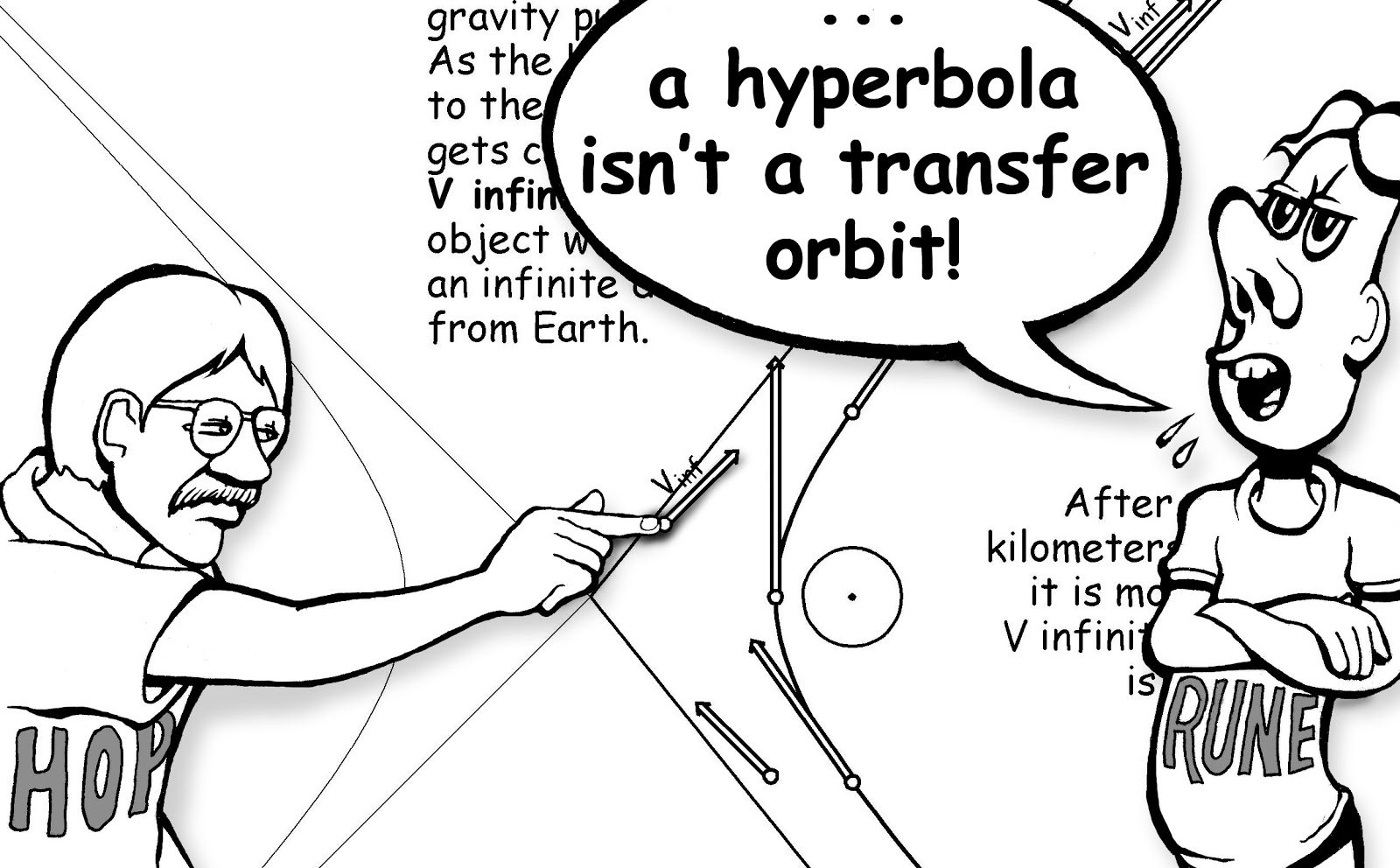
I like to talk about hyperbolas but some people don't see the point. A fellow who calls himself Rune has informed me that transfer orbits aren't hyperbolas.


For most transfer orbits, Rune's right. A Hohmann transfer orbit from Earth to Mars is an ellipse with the sun at a focus:


Planet and asteroid orbits are also ellipses about the sun. So what's the fuss about hyperbolas?

To see let's take a closer look at our Hohmann to Mars:


At one scale we see the path as an ellipse about the sun. But magnify the Hohmann path in earth's neighborhood and we see a hyperbola about the earth.

What is the Vinf and Vesc we use to figure the velocity of this hyperbolic orbit? Let's take another look at our Hohmann ellipse about the sun:


The speed at the Hohmann perihelion (closest point to the sun) is about 33 kilometers/second. The earth is moving about 30 kilometers/second. So at perihelion, the Hohmann orbit is moving 3 km/s faster than earth. This 3 km/s is the Vinf of the hyperbolic orbit about the earth.

At the hyperbola's perigee (closest point to the earth), earth escape velocity is about 11 km/s.
So sqrt (Vescape2 + Vinfinity2) = sqrt (112 + 32) km/s = sqrt (121 + 9) km/s
Which is about 11.5 km/s.
Only .5 km/s greater than the 11 km/s earth escape velocity

And how about the Mars hyperbolic orbit?


Speed at the Hohmann ellipse aphelion (furthest point from the sun) is about 2.8 km/s slower than Mars orbit. This 2.8 km/s is the Vinf of the hyperbolic orbit about Mars.

At a low periaerion, Mars escape velocity is around 4.8 km/s.
So hyperbola speed at the Mars end of the Hohmann is
sqrt (Vescape2 + Vinfinity2) km/s = sqrt(4.82 + 2.82) km/s 
Which is about 5.5 km/s.
Only .7 km/s greater than Mars escape velocity.

Rune as well as illustrious people like Dr. Tom Murphy like to say the delta V from earth C3 = 0 to Mars C3 = 0 is around 6 km/s. Those who know how to patch conics will tell you it's closer to 1.2 km/s.

And to properly patch conics going from planet centric to heliocentric orbits we need to know Vesc and Vinf to find the velocity of planet centered hyperbolas. Since it's important, I'll repeat this:

The formula for a hyperbola's velocity can be easily remembered if you picture Vhyperbola as the hypotenuse of a right right triangle with Vescape and Vinfinity as legs:

Vescape2  +  Vinfinity2  =  Vhyperbola2


Wednesday, February 20, 2013

Golden Tethers

Φ,  also known as the golden ratio, is one of my favorite numbers. It is (sqrt(5) + 1) / 2, approximately 1.618. I've done many paintings and drawings using this number. Here are a couple:

 Two images from my coloring books

The number occurs naturally in designs having a 5 fold symmetry but it also turns up in unexpected places. I was happy to find it when I was playing with orbital tethers.

Vertical Tethers vs Space Elevators


Gravity gradient stabilized vertical tethers are smaller cousins of a full blown space elevator. Jerome Pearson has developed equations giving a space elevator's dimensions and taper ratio.

Some of Pearson's terms:

r0 planet's radius
g0 planet's surface gravity
rs radius of planet's synchronous orbit

For looking at vertical tethers I use P. K. Aravind's equations which I believe are based on Pearson's work. But I substitute the above terms with rf for r0,  gf for g0, and  rc for rs.

Tether Foot
The term rf refers to distance from planet center to tether foot. Imagine a planet the same mass of earth but with a larger radius, rf. Then rf and r0 become the same. Same with surface gravity, gravity at the tether foot would be the same as surface gravity of a planet with radius rf.

Tether Center
The term rc is the distance from planet center to radius at which a natural circular orbit would have the same angular velocity as the tether we're looking. I call this the tether center.  Misnamed since the length above the "center" is greater than the length below, but I can't think of a better word. Again, we can imagine a planet whose angular velocity is the same as our tether's, so rc would become  rs.

Tether Top
The term rt can remain the same. The tether top applies to a vertical tether just as much as it does to a space elevator. The length above the tether center must balance the length below.

Tether Size

I would like to make the tether as small as possible. Smaller size makes for less materials that have to be launched to space. A shorter length makes for greater throughput, less stress allowing less exotic tether materials and smaller taper ratios, and a smaller cross section thus reducing vulnerability to debris impacts.

The tether should be as low as possible. A lower rc makes for a higher angular velocity and a better Oberth benefit.

How low a tether foot can descend is limited by height of atmosphere. We want the foot above the atmosphere as drag would pull the tether down. So  rf is one of the first quantities considered in my tether spreadsheet.

How high to make rt? If releasing a payload from tether top sends the payload on a parabolic trajectory, we can choose any apoapsis by releasing from tether locations between rt  and rc.

Releasing a payload from a point (1+e)1/3 rc will send the payload on conic section trajectory having eccentricity e. The eccentricity of a parabola is 1. So an rt  = 21/3 rc would give us a tether able to deliver payloads to any apoapsis.

Adapting P. K. Aravind's equation (5) from his The physics of the space elevator we have

(rf / 2) * [sqrt(1 + 8(rc/rf)3) - 1] = rt

Recalling we want rt to send payloads on a parabolic path...

(rf / 2) * [sqrt(1 + 8(rc/rf)3) - 1] = 21/3 rc

Setting our units rc = 1 ...

(rf / 2) * [sqrt(1 + 8/(rf3)) - 1] = 21/3

Which comes to the suprising and pleasing result...

rt  = Φ rf

Where Φ is the golden mean, the number I was talking about at the beginning of this blog post.

The velocity of the golden tether's foot is about 68.7% the velocity of a normal circular orbit at rf .

Golden Earth Tether.
The top red orbit is a parabola.
The foot is 300 km above earth's surface. It's moving about 4.8 km/s wrt earth's equator.
Using Kevlar, taper ratio is about 5.1. Tether length is about 4130 km.

Golden Moon Tether.
The top red orbit is a parabola.
The foot is 80 km above moon's surface. It's moving about 1.13 km/s wrt moon's surface.
Using Kevlar, taper ratio is about 1.1. Tether length is about 1125 km.

The tether doesn't have to be golden. Longer tethers would be able to send payloads on hyperbolic orbits (e > 1), useful if interplanetary Hohmann transfers are desired. Shorter tethers would be limited to elliptical orbits (e < 1), but this could still be useful. This spreadsheet allows the user to set eccentricity of exit orbit as well as body's mass and radius. You can also set the altitude of tether foot.


Friday, January 18, 2013

The Dark Side of the Moon

“I'll see you on the dark side of the moon.” Folks with a little astronomy knowledge cringe when they hear these Pink Floyd lyrics. They will patiently explain there is no dark side of the moon. The moon turns a revolution over about 4 weeks. The far side as well as the near side see two weeks of darkness as well as two weeks of sunshine.

But one side is darker. Since the moon is tide locked, the far side never sees earthlight. On the other hand, someone standing on the moon’s nearside will always see earth hovering in the same region of the sky.


Viewed from the earth’s surface, both the sun and the moon subtend about half a degree. The moon’s albedo is .12, meaning it reflects about 12% of the sunlight that hits it. The moon is nearly as dark as charcoal, it only looks bright against the black void of space when our eyes have adjusted to the night’s darkness. Even the above graphic exaggerates the moon's brightness -- the sun is about 100,000 times brighter than the moon.

Viewed from the moon’s surface, the sun subtends half a degree (just as when seen from earth). But earth subtends about 2 degrees. Moreover the earth reflects about 2.5 times more light than the moon, having an albedo of around .3.


Above is a photo taken by NASA's DSCOVR satellite as the moon passed in front of the earth. The Deep Space Climate Observatory is one million miles from the earth, lieing between the earth and sun.

The larger apparent diameter and higher albedo means the earth seen from the moon is about 34 times brighter than the moon seen from earth.

The Bright Side

Let's imagine an astronaut standing at the moon's closest point to the earth. Not far from Mösting A Crater, 0 degrees latitude, 0 degree longitude. From this location, the Earth always hovers directly overhead.

Here is our astronaut pointing his iPhone straight up to snap a picture of the earth. In the foreground an iPad displays the picture he snaps:

It is sunrise. The astronaut sees a half-earth. The long shadows stretching west aren't wholly dark, they are lit by the half-earth above.

As the sun climbs towards high noon, earth is a waning crescent.
   
At noon the earth is at it's dimmest being a very thin crescent or a new-earth. But the moon remains well lit because it's high noon. Except on rare occasions when the sun passes behind the earth.

As the sun sinks towards the horizon, earth is a waxing crescent.

At sunset the waxing crescent has grown to a half-earth. The long shadows stretching east are lightened by the half-earth above.

As the sun sinks deeper behind the horizon, earth is waxing gibbous.

At midnight the astronaut sees a full-earth. This full earth is 34 times brighter than the full moon earthlings see.

From midnight to sunrise, the astronaut sees a waning gibbous earth. At sunrise we're back to where we started.

To The Dark Side

The astronaut hops in his buggy and starts driving east. As he drives closer to the far side, the earth sinks toward the horizon. When the earth is near the horizon it's possible for the sun to be below the horizon when the earth is a dim thin crescent. Even so, the astronaut enjoys strong earthlight for most the night.

When the astronaut drives over into the far side, there's no earthlight. On the far side, it's a deep stygian blackness during the two weeks from sunset to sunrise.

The far side is dark in another sense. Earth is a bright radio source. The far side of the moon is always shadowed from earth's radio noise. Radio astronomers salivate at the thought of a radio telescope under the far side's dark skies.

So you see, the Pink Floyd lyrics make some sense even if you're not under the influence.