"There might be ice in the lunar cold traps," moon haters like to say, "... but if there is, it's hard to reach. It takes way, WAY more delta V to reach the poles than the lower lunar latitudes."
This meme is wrong. Unfortunately it's widespread. The first part of this post will debunk this false notion.
I will describe a route from low earth orbit to the lunar north pole that takes 6.4 km/s and 6 days. It's by no means the only route or even the best route. But I'm using it because it's simple and easy to illustrate.


TLI
The first burn from LEO is TLI or Trans Lunar Injection.
Since the transfer orbit lies on the equatorial plane, the perigee velocity vector is parallel to the low earth orbit velocity vector. Therefore simply subtracting the LEO velocity from the transfer orbit's perigee velocity vector gives the TLI (Trans Lunar Injection) delta V.
But what is the transfer orbit's perigee velocity? And what is LEO velocity at 300 km altitude?
Both these can be found with the vis-viva equation: v = sqrt(GM(2/r - 1/a)
G is the gravitational constant which is about 6.67384e-20 km3 kg-1 s-2
M is the mass of the earth, about 5.972e24 kg.
r is distance from earth's center at TLI. At 300 km altitude this is about 6678 km.
a is the semi-major axis of the orbit. For the low earth orbit a is 6678 km, the same as r. For the transfer orbit, a is (6678 + 384,400)/2 or 195539 km.
Plugging these in we get 10.8 km/s for the transfer orbit's perigee velocity and 7.7 km/s for LEO.
10.8-7.7 = 3.1
The TLI burn is 3.1 km/s.

Entering the Moon's Sphere of Influence
When the ship arrives at apogee, r = 384,400 km. For the moon's orbit a = 384,400. Plugging these quantities into the vis-viva equation we get the moon's velocity as 1.018 km/s. The ship's velocity at perigee is .19 km/s.
But these two vectors aren't parallel. The moon's orbit is inclined to the equatorial plane anywhere from 18 degrees to 29 degrees. We'll pick the worst case scenario: 29 degrees.

Given two sides a and b of a triangle, separated by angle alpha, the third side can be found by the law of cosines:
a2 + b2 - 2ab cos (alpha) = c2. For alpha = 90 degrees, cos(alpha) is zero. So the law of cosines is a more general version of the Pythagorean theorem.
For the triangle above, the third side comes to .86 km/s. The ship enters the moon's sphere of influence traveling .86 km/s with regard to the moon.

Inside the Moon's Sphere of Influence, LOI
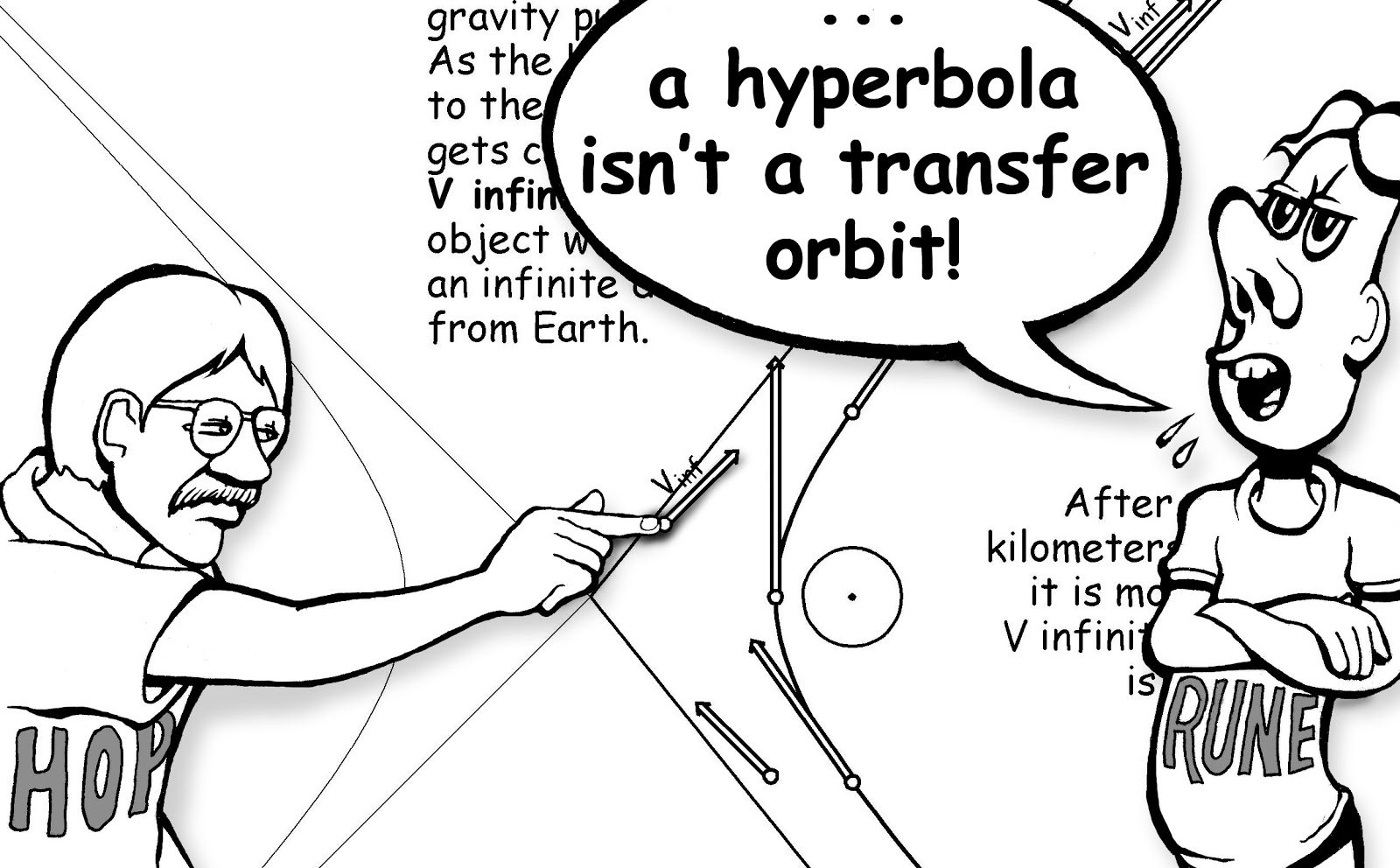
Our ship enters the moon's sphere of influence at lunar longitude 90º. The lunar 90º longitude line lies in a horizontal plane with regard to the earth. At apogee the ship's vector is also horizontal with regard to the earth so the ship's velocity vector lies in same plane. Inside the moon's sphere of influence, the ship's path can be modeled as a hyperbola with the focus at the moon's center. The moon's center also lies in the 90º longitude plane. Since the hyperbolic orbit is coplanar with a plane that cuts through the moon's poles, this hyperbolic orbit is polar.

Using the Law of Sines we can find the angle between the velocity vector with regard to the moon and the local vertical with regard to the moon. It is 5.5 degrees.

Impact parameter of our hyperbolic orbit is sin(5.5º) * 60,000 km. Or about 6090 kilometers.

Given a .86 km/s Vinfinity vector and a 6090 km impact parameter, the hyperbola's perilune is 633 kilometers above the moon's surface or 2371 kilometers from the moon's center. A hyperbola's velocity is sqrt(Vescape2 + Vinfinity2). Our Vinfinity is .86 km/s. Escape velocity is sqrt(2GM/r). Since we're in the moon's sphere of influence, we will use the moon's mass for M, 7.35e22 kg. At 2371 kilometers from the moon's center, Vescape is about 2 km/s. Sqrt(.862 + 22) is about 2.2.
Our hyperbola's perilune velocity is 2.2 km/s.

We want to get from a 633 km altitude hyperbola perilune to an elliptical orbit having 633 altitude km apolune and 20 km perilune. This ellipse would have semi axis a = 2064 km. Then we want to move to a low lunar orbit at 20 km altitude. Using the vis-viva equation we can get these numbers:

.9 km/s for LOI (Lunar Orbit Insertion) from a hyperbolic orbit
and
.2 km/s for injection to a low lunar orbit.
We wait until our low lunar orbit takes us to the north or south pole. We need to kill the orbit's 1.6 km/s. As the orbit slows, the ship will lose altitude gaining vertical velocity from gravity. To make a soft landing we need to counteract gravity. I estimate gravity loss will cost .5 km/s.
.5 + 1.6 km/s = 2.1 km/s
2.1 km/s for descent and landing.
The total delta V from LEO to landing is the sum of 4 burns: TLI, LOI, insertion to LLO, and landing.
3.1 + .9 + .2 + 2.1 = 6.4.
6.4 km/s is the total delta V from LEO to landing at the moon's north pole.
Period of an elliptical orbit is 2 pi sqrt(a3 / (GM)). The transfer orbit from LEO to a 384,400 km apogee is about 10 days. We travel half that orbit so
5 days from LEO to 384,000 apogee.
We can find the angular momentum of the hyperbolic orbit about the moon by doing a cross product of it's position vector and velocity vector at perilune. Magnitude of the hyperbola's angular momentum vector is 2371 km * 2.2 km/s which comes to about 5200 square kilometers per second. The magnitude of an orbit's angular momentum is twice the area the orbit sweeps out in a given time.
To measure twice the area the hyperbola swept out from entering SOI to perilune, I did a scale drawing and measured in Photoshop:

310 million square kilometers divided by 5200 square kilometers per second comes to about 60,000 seconds or about .7 days.
.7 days from SOI to hyperbola perilune.
We can use 2 pi sqrt(a3 / (GM)) to get the period of the orbit from a 633 km altitude to a 20 km altitude. This orbit has period of about .1 days. We traverse half this orbit. .5 * .1 = .05
.05 days from 633 km altitude to 20 km altitude.
We can also use 2 pi sqrt(a3 / (GM)) to get the period of a low lunar orbit at a 20 kilometer altitude. The LLO period is .08 days (about 1.8 hours).
Less than .08 days to get to either the north or south pole.
5 + .7 + .05 + .08 = 5.83. I will round up to 6.
6 days is the total time from LEO to landing at the north pole.
Asteroid Ice Isn't So Easy to Reach
Main Belt Asteroids
I will look at water ice in the Main Belt asteroids, short period comets, and what I call accessible NEOs. By accessible NEOs I mean those objects retrievable by a vehicle as described in the Keck Report
There is evidence that some of the Main Belt asteroids have water ice. Three possibilities are Ceres, 24 Themis, and 65 Cybele.
Here is a table showing delta v, launch window frequency (aka synodic period), trip time, and surface gravity:
The above numbers come from a model that assumes circular, coplanar orbits. 24 Themis has less than 1 degree inclination, so coplanar orbits are a good approximation. But 65 Cybele is inclined 3.5º to the ecliptic and Ceres 10.6º. So the above table underestimates the delta V for these two asteroids.
All three take considerably more delta V to reach than the lunar poles.
Lunar launch windows occur every two weeks from a given LEO orbit. Trip time is less than a week. By these metrics, the moon has a huge advantage over the main belt asteroids.

A common myth is that, due to their shallow gravity wells, return to earth from an asteroid takes virtually no delta V. Unless the asteroid has a near earth perihelion or aphelion, the heliocentric transfer orbit have a different velocity at asteroid rendezvous. For example, 24 Themis moves about the sun at about 16.8 km/s. The transfer orbit is moving about 11.7 km/s at rendezvous. Regardless if the transfer orbit is 24 Themis to Earth, or Earth to 24 Themis, the needed delta V is 5.1 km/s.
Some asteroids may be amenable to rendezvous via low thrust but high ISP ion rockets. But not these. The vehicle described in the Keck Report has a thrust of 2 newtons and a dry mass of 5.5 tonnes. That comes to about .0004 newtons per kilogram with no propellant. So to have a thrust/weight ratio greater than 1, surface gravity would need to be less than .0004 meters/second^2. It's hard to imagine an ion rocket getting off the ground on any of these three asteroids.
I will look at water ice in the Main Belt asteroids, short period comets, and what I call accessible NEOs. By accessible NEOs I mean those objects retrievable by a vehicle as described in the Keck Report
There is evidence that some of the Main Belt asteroids have water ice. Three possibilities are Ceres, 24 Themis, and 65 Cybele.
Here is a table showing delta v, launch window frequency (aka synodic period), trip time, and surface gravity:
Asteroid Name |
LEO to Transfer (km/s) |
Transfer to Rendezvous (km/s) |
Synodic Period (Years) |
Trip Time (Years) |
Surface Gravity (m/s^2) |
| Ceres | 4.9 | 4.9 | 1.28 | 1.29 | .28 |
| 24 Themis | 5.2 | 5.1 | 1.22 | 1.48 | .075 |
| 65 Cybele | 5.4 | 5.3 | 1.19 | 1.65 | .07 |
The above numbers come from a model that assumes circular, coplanar orbits. 24 Themis has less than 1 degree inclination, so coplanar orbits are a good approximation. But 65 Cybele is inclined 3.5º to the ecliptic and Ceres 10.6º. So the above table underestimates the delta V for these two asteroids.
All three take considerably more delta V to reach than the lunar poles.
Lunar launch windows occur every two weeks from a given LEO orbit. Trip time is less than a week. By these metrics, the moon has a huge advantage over the main belt asteroids.

A common myth is that, due to their shallow gravity wells, return to earth from an asteroid takes virtually no delta V. Unless the asteroid has a near earth perihelion or aphelion, the heliocentric transfer orbit have a different velocity at asteroid rendezvous. For example, 24 Themis moves about the sun at about 16.8 km/s. The transfer orbit is moving about 11.7 km/s at rendezvous. Regardless if the transfer orbit is 24 Themis to Earth, or Earth to 24 Themis, the needed delta V is 5.1 km/s.
Some asteroids may be amenable to rendezvous via low thrust but high ISP ion rockets. But not these. The vehicle described in the Keck Report has a thrust of 2 newtons and a dry mass of 5.5 tonnes. That comes to about .0004 newtons per kilogram with no propellant. So to have a thrust/weight ratio greater than 1, surface gravity would need to be less than .0004 meters/second^2. It's hard to imagine an ion rocket getting off the ground on any of these three asteroids.
Short Period Comets
Next I will look at short period comets. A body that has recently outgassed is likely to have volatile ices.
Among the short period comets, Comet Encke has the shortest known semi-major axis, 2.22 A.U. It has a high eccentricity, e = ~.85. This means it has a perihelion quite close to the sun at .34 AU inside the orbit of Mercury. It has an aphelion at about 4.1 AU, out past the main belt.

It gets quite hot at perihelion, a black body temp of 460K (assuming an albedo of .15). And fairly cold at aphelion, 132K. But it spends more time in the aphelion neighborhood, so it's average black body temp is 167 K. If it had a circular orbit of radius 2.22 AU, the average black body temp would be 180K. So more eccentric orbits have the effect of lowering average black body temp throughout the orbit.
While the big eccentricity makes the comet a little cooler, it also makes for healthy delta V. Here are two possible routes from earth to Encke:
 Where rendezvous is at Encke's aphelion....
 ....or perihelion, there is big delta V. This isn't considering Encke's healthy inclination. Most comets have a good inclination that will boost delta V.
But if an asteroid/comet has a 1 A.U. perihelion, that changes the picture quite a lot. For the sake of argument I will imagine there is a comet JohnD with 0º inclination, 1.9 AU semi-major axis and a 1 AU perihelion. The fictitious comet JohnD is named after John DeLaughter, a planetologist I've been arguing with. Much of this blog post comes from that argument.
 You may have noticed I've been drawing the transfer orbits sort of purplish. Like Hohmann orbits, the transfer orbits have been tangent to the departure and destination orbits. Thus delta V is only needed for speed change, not direction change. Well, Comet JohnD's orbit is already tangent to earth's orbit. Thus when the comet comes around our neighborhood, the only delta V needed is to leave earth orbit for TJI (Trans JohnD Injection). Rendezvous with the asteroid is virtually no delta delta V. In this case Vinfinity would be about 6.4 km/s. Therefore TJI from LEO is around 5 km/s. It would take less delta V to reach Comet JohnD than the moon.
Likewise for the return trip, wait until asteroid Johnd passes near earth at perihelion. A slight nudge can send a cargo to an earth atmosphere grazing orbit. Let aerobraking take care of most the delta V. Pretty sweet, huh?
Not so fast. The period of Comet JohnD is 2.619 years. When Comet JohnD returns to perihelion, earth will have advanced (360 + 360 + 222.8) degrees. The earth is nowhere near the comet, it's location at the 2nd perihelion is denoted by the number 2 in right part of the graphic above. Each circuit of the comet sees earth advance 222.8 degrees. Earth and the comet won't be in the same neighborhood for 22 periods! 22 * 2.619 = 57. 57.6 years.
If Chris Lewicki of Planetary Resources sets up a water mine on Comet JohnD, he'd have to wait 58 years to send the first shipment back to earth. Or else pay a delta V penalty.
Also microgravity mining in a vacuum is something the human race has zero experience doing. Acquiring the needed experience will be a trial and error process. Thus multiple trips would be needed to establish infra-structure. In the case of Comet JohnD, 3 trips to the comet to establish infra-structure would take 173 years.
The rarity of launch windows more than nullifies the slight delta V advantage this comet has over the moon.
Moreover, it is less likely Comet JohnD would have water ice in it's interior. Recall the average black body temperature of Encke was 167 K. And this is the shortest period comet known. Assuming an albedo of .15, Comet John D would have an average temp of 190 K:

This is 23 K warmer than Encke. A 23 K difference is the same as a 41.4º F difference. The difference between freezing and comfortable room temperature. Water ice in a vacuum starts sublimating at healthy rate at around 150 K. Being surrounded by clay and dust might mitigate sublimation loss for a time. But less so when the average temperature is boosted by 41º F. Encke is a rare comet having the shortest known semi-major axis at 2.22 AU. In my opinion a dead comet with a 1.9 AU axis is less likely to keep volatile ices at its core.
Accessible Asteroids: small asteroids with an earth-like orbit.
While there are many near earth objects quite close in terms of delta V, launch windows to these close objects are rare. Which makes establishing infra-structure more difficult. Also very rare are the opportunities to deliver the asteroid's resources to earth's neighborhood. Due to these considerations, NEOs fell off my radar screen.
Then in April 2012 the Keck Report was published.
Keck Report Authors include Chris Lewicki -- chief engineer of Planetary Resources, John S. Lewis - author of Mining the Sky and Rain of Iron and Ice, Don Yeomans - Manager of NASA's Near-Earth Object Program Office, Rusty Schweickart - chair emeritus of the B612 Foundation. There are many respected engineers and scientists among the authors.
The authors did the numbers demonstrating it's possible to park a small asteroid in high lunar orbit. I've examined the numbers and they are only mildly optimistic. In my opinion the vehicle described is doable.
Parking the rock in lunar orbit completely changes the picture. Now the rock has launch windows each two weeks. Trip time is less than a week.
Moreover, light lag latency from earth's surface is only 3 seconds. Since signal strength scales with inverse square of distance, the rock's proximity makes for good bandwidth. The rock is amenable to being worked by telerobots.
The Keck Report reversed my opinion. I now believe mining a retrieved asteroid is doable.
Retrievable asteroids would be rocks similar to 2008 HU4 -- small and having a semi major axis close to 1 AU. Also small eccentricity and inclination.
Here's a look at 2008 HU4's average temperature (assuming .15 albedo):

This is 117º F hotter than Comet JohnD. What's the life span of a small ice ball at this temperature?
John DeLaughter cites The Stability of Volatiles in the Solar System which says, in part, "a 1 km sphere at 1 a.u. is stable for 3,000 years,"
It's possible that near passages with the earth or other planets could lower a comet's aphelion. I would guess there are some dead comets with orbital elements similar to 2008 HU4. But how many of these were perturbed into their earth like orbits within the past 3,000 years?
And retrievable rocks are much smaller than 1 kilometer. More like 5 to 7 meters.
Equation (6) from Stability of Volatiles:
tmax = r0/(dr/dt) = r0ρ/É.
The number of interest here is r0, initial radius. The ice ball's life scales with initial radius. 7 meters/1000 meters = .007. .007 *3000 = 21 years. A 7 meter ice ball at 1 a.u. would last 21 years.
John DeLaughter believes a blanket of loose soil could reduce water loss by a factor of 10 to 20. He argues the soil's permeability and tortuosity would slow sublimation. But he neglects to mention that it would also lower albedo. The paper he cites assumes a .6 albedo for ice balls. A comet's exterior mantle more typically has albedo of .1. Dark objects absorb more light and get hotter than pale objects. But for the sake of argument, I will give him his factor of 20. That's 21 * 20 years. How many comets have been perturbed into an earth like orbit within the past 420 years?
Next I will look at short period comets. A body that has recently outgassed is likely to have volatile ices.
Among the short period comets, Comet Encke has the shortest known semi-major axis, 2.22 A.U. It has a high eccentricity, e = ~.85. This means it has a perihelion quite close to the sun at .34 AU inside the orbit of Mercury. It has an aphelion at about 4.1 AU, out past the main belt.

It gets quite hot at perihelion, a black body temp of 460K (assuming an albedo of .15). And fairly cold at aphelion, 132K. But it spends more time in the aphelion neighborhood, so it's average black body temp is 167 K. If it had a circular orbit of radius 2.22 AU, the average black body temp would be 180K. So more eccentric orbits have the effect of lowering average black body temp throughout the orbit.
While the big eccentricity makes the comet a little cooler, it also makes for healthy delta V. Here are two possible routes from earth to Encke:


But if an asteroid/comet has a 1 A.U. perihelion, that changes the picture quite a lot. For the sake of argument I will imagine there is a comet JohnD with 0º inclination, 1.9 AU semi-major axis and a 1 AU perihelion. The fictitious comet JohnD is named after John DeLaughter, a planetologist I've been arguing with. Much of this blog post comes from that argument.

Likewise for the return trip, wait until asteroid Johnd passes near earth at perihelion. A slight nudge can send a cargo to an earth atmosphere grazing orbit. Let aerobraking take care of most the delta V. Pretty sweet, huh?
Not so fast. The period of Comet JohnD is 2.619 years. When Comet JohnD returns to perihelion, earth will have advanced (360 + 360 + 222.8) degrees. The earth is nowhere near the comet, it's location at the 2nd perihelion is denoted by the number 2 in right part of the graphic above. Each circuit of the comet sees earth advance 222.8 degrees. Earth and the comet won't be in the same neighborhood for 22 periods! 22 * 2.619 = 57. 57.6 years.
If Chris Lewicki of Planetary Resources sets up a water mine on Comet JohnD, he'd have to wait 58 years to send the first shipment back to earth. Or else pay a delta V penalty.
Also microgravity mining in a vacuum is something the human race has zero experience doing. Acquiring the needed experience will be a trial and error process. Thus multiple trips would be needed to establish infra-structure. In the case of Comet JohnD, 3 trips to the comet to establish infra-structure would take 173 years.
The rarity of launch windows more than nullifies the slight delta V advantage this comet has over the moon.
Moreover, it is less likely Comet JohnD would have water ice in it's interior. Recall the average black body temperature of Encke was 167 K. And this is the shortest period comet known. Assuming an albedo of .15, Comet John D would have an average temp of 190 K:

This is 23 K warmer than Encke. A 23 K difference is the same as a 41.4º F difference. The difference between freezing and comfortable room temperature. Water ice in a vacuum starts sublimating at healthy rate at around 150 K. Being surrounded by clay and dust might mitigate sublimation loss for a time. But less so when the average temperature is boosted by 41º F. Encke is a rare comet having the shortest known semi-major axis at 2.22 AU. In my opinion a dead comet with a 1.9 AU axis is less likely to keep volatile ices at its core.
Accessible Asteroids: small asteroids with an earth-like orbit.
While there are many near earth objects quite close in terms of delta V, launch windows to these close objects are rare. Which makes establishing infra-structure more difficult. Also very rare are the opportunities to deliver the asteroid's resources to earth's neighborhood. Due to these considerations, NEOs fell off my radar screen.
Then in April 2012 the Keck Report was published.
Keck Report Authors include Chris Lewicki -- chief engineer of Planetary Resources, John S. Lewis - author of Mining the Sky and Rain of Iron and Ice, Don Yeomans - Manager of NASA's Near-Earth Object Program Office, Rusty Schweickart - chair emeritus of the B612 Foundation. There are many respected engineers and scientists among the authors.
The authors did the numbers demonstrating it's possible to park a small asteroid in high lunar orbit. I've examined the numbers and they are only mildly optimistic. In my opinion the vehicle described is doable.
Parking the rock in lunar orbit completely changes the picture. Now the rock has launch windows each two weeks. Trip time is less than a week.
Moreover, light lag latency from earth's surface is only 3 seconds. Since signal strength scales with inverse square of distance, the rock's proximity makes for good bandwidth. The rock is amenable to being worked by telerobots.
The Keck Report reversed my opinion. I now believe mining a retrieved asteroid is doable.
Retrievable asteroids would be rocks similar to 2008 HU4 -- small and having a semi major axis close to 1 AU. Also small eccentricity and inclination.
Here's a look at 2008 HU4's average temperature (assuming .15 albedo):

This is 117º F hotter than Comet JohnD. What's the life span of a small ice ball at this temperature?
John DeLaughter cites The Stability of Volatiles in the Solar System which says, in part, "a 1 km sphere at 1 a.u. is stable for 3,000 years,"
It's possible that near passages with the earth or other planets could lower a comet's aphelion. I would guess there are some dead comets with orbital elements similar to 2008 HU4. But how many of these were perturbed into their earth like orbits within the past 3,000 years?
And retrievable rocks are much smaller than 1 kilometer. More like 5 to 7 meters.
Equation (6) from Stability of Volatiles:
tmax = r0/(dr/dt) = r0ρ/É.
The number of interest here is r0, initial radius. The ice ball's life scales with initial radius. 7 meters/1000 meters = .007. .007 *3000 = 21 years. A 7 meter ice ball at 1 a.u. would last 21 years.
John DeLaughter believes a blanket of loose soil could reduce water loss by a factor of 10 to 20. He argues the soil's permeability and tortuosity would slow sublimation. But he neglects to mention that it would also lower albedo. The paper he cites assumes a .6 albedo for ice balls. A comet's exterior mantle more typically has albedo of .1. Dark objects absorb more light and get hotter than pale objects. But for the sake of argument, I will give him his factor of 20. That's 21 * 20 years. How many comets have been perturbed into an earth like orbit within the past 420 years?
5 to 7 meter diameter rocks with an ~1 AU semi-major axis are unlikely to have water ice. This is not to say such rocks have no water! I believe there are many accessible rocks with water in the form of hydrated clays. But such rocks are water rich in the same way concrete is water rich. Ice deposits are more easily exploited than hydrated clays. If the lunar cold traps do indeed have large, thick ice deposits, I believe the moon would be a better source of extra-terrestrial propellant.